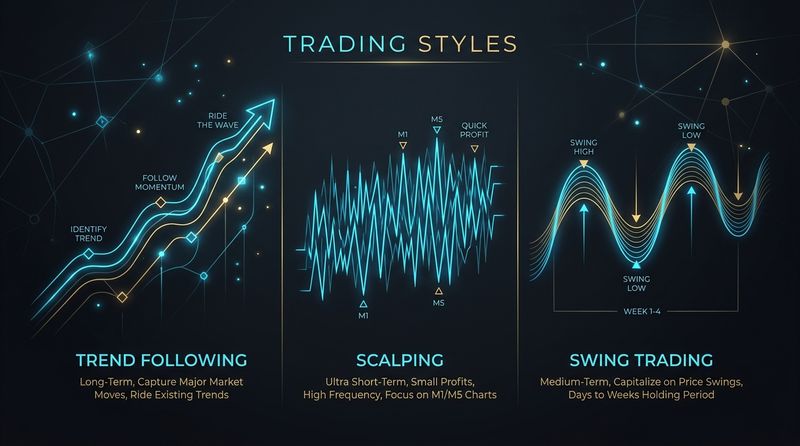
Imagine being a commercial airline pilot. Your job is to take off from one airport, fly through whatever weather conditions arise, and land safely at your destination before your shift ends. You never leave your plane parked in mid-air overnight. In the stock market, Day Trading (or intraday trading) follows the exact same logic. You enter a position after the market opens in the morning, navigate the day's volatility, and close ("land") your trade before the market shuts down for the day. No matter what happens, you carry zero positions overnight.
Day trading is highly popular in India, fueled by the dream of quick daily profits and the availability of leverage from brokers. However, statistics published by SEBI reveal a sobering reality: **over 90% of retail intraday traders lose money**. The main reason is not a lack of strategy, but a failure to understand market mechanics, leverage, and risk management. This step-by-step guide is designed to give you a solid foundation to navigate the Indian intraday markets safely and systematically.
The Indian Market Context: Key Rules of the Game
Before you place your first intraday trade, you must understand the rules and schedule of the Indian stock exchanges (NSE and BSE):
- Market Timings: The market opens at 9:15 AM and closes at 3:30 PM. The pre-market session runs from 9:00 AM to 9:15 AM (with order entry between 9:00 AM and 9:08 AM to determine the opening price).
- MIS vs. CNC: When placing an order, you must select the product type. MIS (Margin Intraday Square-off) is used for intraday trades. CNC (Cash and Carry) is used for delivery trades where you buy and hold shares in your Demat account.
- Auto-Square Off: If you do not close your active MIS positions by a specific time (typically 3:15 PM or 3:20 PM depending on the broker), the broker's automated system will liquidate your position at the prevailing market price. Brokers charge an additional penalty fee (often ₹50 + GST per order) for auto-square off, so always close your positions manually!
Margin and Leverage: A Double-Edged Sword
Brokers in India offer leverage for intraday trading. Under SEBI guidelines, you can get up to 5x leverage on highly liquid stocks. This means that if you have ₹20,000 in your trading account, you can buy up to ₹100,000 worth of shares for intraday trading.
While leverage can multiply your profits, it also multiplies your losses. Let's look at the math:
The Leverage Trap Explained:
Suppose you use 5x leverage to buy ₹100,000 worth of stock with ₹20,000 capital.
- If the stock price rises by 2%, the value becomes ₹102,000. You make ₹2,000 profit. This is a 10% return on your ₹20,000 capital.
- If the stock price falls by 4%, the value becomes ₹96,000. You lose ₹4,000. This is a 20% loss of your capital.
As you can see, a small adverse move in the stock can quickly wipe out a significant portion of your account when using maximum leverage.
Step-by-Step Intraday Trading Workflow
Successful day trading is a systematic routine. Here is the process you should follow every single trading day:
Step 1: Pre-Market Analysis (8:30 AM to 9:15 AM)
Check global market indicators. Look at the performance of US markets (S&P 500, Nasdaq) from the previous night and check Asian markets (Nikkei, Hang Seng) in the morning. Pay close attention to the **GIFT Nifty** (formerly SGX Nifty), which trades in GIFT City, Gujarat, as it provides a strong indication of whether the Indian market will open gap-up, gap-down, or flat.
Step 2: Stock Selection (9:15 AM to 9:30 AM)
Do not try to watch 50 stocks. Focus on a watchlist of 5-10 highly liquid stocks or pick stocks that have active catalysts. Good intraday candidates include:
- Stocks reporting quarterly earnings today or late yesterday.
- Stocks impacted by corporate announcements (mergers, government orders, regulatory approvals).
- Stocks showing high volume and breaking out of their pre-market ranges.
Step 3: Execution and Strategy (Opening Range Breakout)
A classic, beginner-friendly intraday strategy is the Opening Range Breakout (ORB):
- Wait for the first 15 minutes of the market (9:15 AM to 9:30 AM) to pass. Identify the high and low prices established during this initial 15-minute candle.
- If the price breaks above the 15-minute high on strong volume, enter a long position (Buy).
- If the price breaks below the 15-minute low, enter a short position (Sell).
- Place your stop-loss at the opposite end of the 15-minute candle or near the middle of the range. Target a profit that is at least 1.5 to 2 times the size of your risk.
MIS (Intraday) vs. CNC (Delivery)
Understanding the key differences between these two options is vital for account safety:
| Parameter | MIS Order (Intraday) | CNC Order (Delivery) |
|---|---|---|
| Holding Period | Must close before 3:15 PM on the same day. | Can hold for days, months, or years. |
| Leverage | Up to 5x margin provided by the broker. | No leverage (requires 100% cash up front). |
| Short Selling | Allowed. Can sell first and buy later. | Not allowed. Can only sell shares you already own. |
| Demat Account | Shares never enter your Demat account. | Shares are credited to Demat in T+1 days. |
The Golden Rules of Day Trading Risk Management
If you want to survive in the intraday arena, you must treat trading as a business of probability. Follow these ironclad rules:
- Apply the 1% Rule: Never risk more than 1% of your total account capital on a single trade. If you have ₹50,000, your maximum loss on any single trade should not exceed ₹500. Calculate your share quantity based on this risk, not your leverage capacity.
- Set a daily loss limit: Determine a maximum loss limit for the day (e.g., 3% of your account). If you hit this limit, close your computer, walk away, and do not touch the market until tomorrow. This prevents "revenge trading" where you place emotional, high-risk trades to recover losses.
- Always place a stop-loss order in the system: Do not rely on a "mental stop-loss." Sudden news or a market flash crash can wipe out your account before you can manually click the exit button.
- Avoid illiquid penny stocks: Stick to stocks with high daily volume. In low-volume stocks, you may get trapped in "lower circuits" where there are no buyers, preventing you from executing your stop-loss and leading to massive losses.
Conclusion
Day trading is a high-skill, fast-paced discipline that can offer freedom and income if approached with the right mindset. However, it is not a get-rich-quick scheme. It requires the precision of a pilot, the analytical nature of a scientist, and the discipline of a soldier. By understanding the Indian market rules, avoiding the abuse of margin, limiting your risk per trade, and executing a consistent playbook, you can protect your capital and build a sustainable trading career. Focus on survival first, and the profits will follow.
Educational & Regulatory Disclaimer
This publication is created strictly for educational and financial literacy purposes. InnocentInvestor is not a SEBI-registered investment advisor or research analyst. Stock market investments are subject to market risks; please consult a qualified financial planner before making investment decisions.