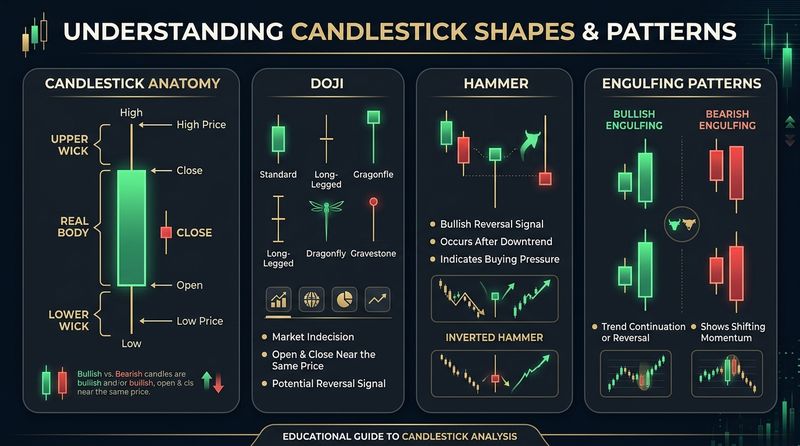
Imagine going to sleep with a stock trading at $100, only to wake up the next morning and find it trading at $108. On the chart, a blank white space separates yesterday's closing candle from today's opening candle. In financial markets, this blank space is known as a **Gap**.
Gaps occur when an asset opens significantly higher or lower than the previous session's close, leaving a structural vacuum on the chart. They are typically sparked by overnight events, such as corporate earnings releases, macroeconomic data, regulatory changes, or sudden global events. For retail investors, gaps can be terrifying, but for price action traders, they represent major opportunities. This guide will teach you the four types of gaps and how to trade them strategically.
The Four Core Types of Gaps
Not all gaps are created equal. Trying to buy a stock because it gapped up can lead to massive losses if it is the wrong kind of gap. Technical analysts classify gaps into four distinct categories based on their position in the market cycle:
1. Common Gaps (Trading Range Gaps)
Common gaps form inside a quiet trading range or consolidation zone. They are relatively small and represent minor imbalances in overnight buy/sell orders.
Behavior: Common gaps are almost always **filled quickly** (often during the same session). "Filling the gap" means the price returns to the level of the previous day's close, closing the physical blank space on the chart.
2. Breakaway Gaps (Trend Starters)
A Breakaway Gap occurs when the price breaks out of a major technical formation (like a double top, head and shoulders, or horizontal trading range).
Behavior: These are high-momentum gaps accompanied by massive volume. Breakaway gaps are **rarely filled immediately**. They represent a structural shift in supply and demand, launching the price into a brand new trend.
3. Runaway Gaps (Continuation Gaps)
A Runaway Gap—often called a Continuation Gap—occurs in the middle of a strong, established trend. It is caused by a sudden rush of late buyers or short-sellers who realize they missed the initial move and panic-enter positions.
Behavior: Like breakaway gaps, runaway gaps are **not filled quickly**. They act as confirmation that the current trend has strong institutional support and is accelerating.
4. Exhaustion Gaps (Trend Killers)
An Exhaustion Gap occurs near the very end of a long, mature trend. It represents a final, desperate push by retail traders caught in FOMO (Fear of Missing Out), buying at the absolute high of a bubble or selling at the absolute bottom of a panic.
Behavior: Exhaustion gaps are followed by a rapid deceleration in volume, followed by a sharp price reversal. The gap is **filled very quickly**, confirming the trend is dead.
Comparison: Gap Profiles
| Gap Type | Volume Level | Likelihood of Fill | Market Meaning |
|---|---|---|---|
| Common Gap | Low / Moderate | Very High (Fast) | Sideways range noise; ignore or trade reversal. |
| Breakaway Gap | Extremely High | Low | Beginning of a new major trend; trade continuation. |
| Runaway Gap | Moderate / High | Very Low | Trend acceleration; ride momentum. |
| Exhaustion Gap | High to Low decline | High (Immediate Reversal) | Trend death; prepare for reversal trades. |
Two Core Gap Trading Strategies
Traders approach gaps in two ways: they either **trade in the direction of the gap** (momentum play) or they **trade against the gap** (reversal/gap-fill play).
Strategy 1: The Breakaway Gap Play (Trading Momentum)
Use this strategy to ride major breakouts:
1. Identify a stock consolidating in a clear rectangular range for at least a few weeks.
2. On market open, watch for a gap that launches the price cleanly outside the range on high volume.
3. **Execution:** Enter a long position (if gapped up) or short position (if gapped down) on the 15-minute chart once the initial opening volatility settles. Place your stop loss just inside the broken consolidation range or at the midpoint of the gap. Set your target at a 2:1 risk-to-reward ratio.
Strategy 2: Fading the Common Gap (The Gap Fill Play)
Use this strategy to trade short-term range reversals:
1. Locate a stock trading inside a well-defined horizontal trading range.
2. Look for a gap up that approaches the upper resistance line of the range.
3. Watch the opening 15-minute candle. If it shows selling pressure (such as a Shooting Star or Gravestone Doji rejection of resistance), enter short.
4. **Execution:** Place your stop loss above the resistance high. Set your profit target at yesterday's closing price (the gap fill level). Gaps are filled because of order matching and profit-taking, making this a highly consistent short-term scalp.
Common Mistakes in Gap Trading
- Fading Breakaway Gaps: The most common retail mistake is trying to short every gap up. Retail traders assume "all gaps must be filled." While this is true for common gaps, shorting a breakaway gap on a high-growth stock (like Nvidia or Reliance after positive earnings) is a quick way to blow an account. The trend will keep moving against you.
- Trading Before opening Volatility Settles: The first 5 to 15 minutes of the trading day are highly volatile, filled with erratic swings. Always wait for the first 15-minute candle to close to confirm the market's direction before entering.
- Ignoring the Catalyst: Always check why the gap occurred. A gap caused by a minor analyst upgrade is a common gap that can be faded. A gap caused by a massive takeover bid or block deal is a breakaway gap that should be traded in the direction of the move.
Conclusion
Gaps are the ultimate price action signals of supply and demand imbalances. By identifying the type of gap—Common, Breakaway, Runaway, or Exhaustion—and observing volume levels and range context, you can avoid dangerous traps and execute highly profitable momentum or reversion trades.
Educational & Regulatory Disclaimer
This publication is created strictly for educational and financial literacy purposes. InnocentInvestor is not a SEBI-registered investment advisor or research analyst. Stock market investments are subject to market risks; please consult a qualified financial planner before making investment decisions.