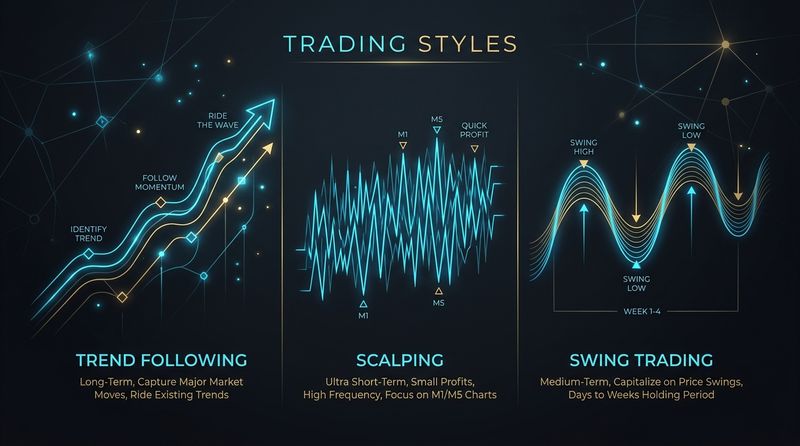
Have you ever watched a hummingbird in a garden? It moves with incredible, blur-like speed, darting from flower to flower, taking tiny sips of nectar before moving on. It never rests on a single branch for long, and it certainly doesn't wait for a seed to grow into a flower. In the financial markets, Scalping is the trading equivalent of the hummingbird. Scalpers enter and exit the market within seconds or minutes, aiming to capture tiny price movements ("micro-profits") dozens or hundreds of times a day.
Scalping represents the fastest form of manual trading. While swing traders hold stocks for weeks and day traders hold them for hours, scalpers measure their holding times in seconds. Their philosophy is simple: small market moves are far easier to predict than large ones, and by keeping holding times extremely short, they minimize exposure to market risk. However, scalping is also one of the most physically demanding, stressful, and expensive styles of trading. Let's look at the mechanics, the essential tools, and the hidden traps that catch most beginners.
The Core Philosophy: Velocity and Micro-Profits
The goal of a scalper is not to hit home runs. They don't care if a stock goes up 20% by the end of the day. They only care about capturing a price spread of a few paise or cents. A typical trade might involve buying 2,000 shares of a stock at ₹250.00 and selling them a minute later at ₹250.40, pocketing a quick ₹800. The scalper will then immediately search for the next setup, repeating this loop 30 to 100 times a day.
Scalpers rely on the law of large numbers. They accept that they will have many losing trades, but they design their system so that their average win is slightly larger than their average loss, or their win rate is high enough to generate a net profit. Because positions are closed almost immediately, scalpers are completely unaffected by overnight news, earnings releases, or general macroeconomic trends. They sleep peacefully at night with 100% cash in their accounts.
Essential Tools of the Scalper
Due to the high speed of execution required, standard charting setups and basic broker websites will not work for scalping. Traders require specialized tools:
1. Tick Charts and 1-Minute Charts
Standard day traders use 15-minute or 5-minute charts. Scalpers find these far too slow. They use 1-minute candlestick charts, or even Tick Charts. Unlike time-based charts, a tick chart creates a new bar after a set number of transactions (e.g., every 50 or 100 trades), regardless of time. This reveals institutional activity and order flow in real-time during periods of high market activity.
2. Level 2 Market Depth (The Order Book)
The Level 2 screen shows the actual queue of buy orders (bids) and sell orders (asks) at different price levels. Scalpers read this data to see where large buy blocks or sell walls are placed. For example, if a stock is trading at ₹500, and there is a massive buy wall of 50,000 shares sitting at ₹499.50, a scalper knows that the price is highly unlikely to fall below that level in the next few minutes. They will buy at ₹499.60, expecting a bounce.
3. Direct Market Access (DMA) and Hotkeys
In scalping, a delay of one second can mean the difference between a winning trade and a losing trade. Scalpers use specialized trading platforms that offer Direct Market Access (DMA) to routing execution directly to the exchange. They also use keyboard shortcuts (hotkeys) to buy, sell, and cancel orders instantly without using a mouse.
Three Classic Scalping Techniques
Scalpers generally employ one of three main methodologies to find their targets:
- Bid-Ask Spread Scalping (Market Making): The trader simultaneously places a buy order at the bid price and a sell order at the ask price of a highly liquid stock. If both fill, they capture the spread (the difference between the buy and sell price). This requires zero directional bias but is highly vulnerable to sudden trend moves.
- Range Scalping: The trader identifies a stock trading in a tight consolidation range. They buy at the bottom of the range (support) and sell at the top of the range (resistance), exiting the moment the price shows signs of stalling.
- Momentum Scalping: The trader waits for a stock to break out of a consolidation or daily high. They buy the breakout, ride the immediate surge for a few seconds as other traders chase it, and exit at the first sign of slowing velocity.
The Silent Killer: Transaction Costs
The single biggest pitfall for beginner scalpers is the cost of executing trades. Every time you buy and sell, you pay fees. In India, these include brokerage, Securities Transaction Tax (STT), Exchange Transaction Charges, GST, SEBI turnover fees, and stamp duty.
While a 0.05% fee seems tiny on a single trade, if you execute 50 round-trip trades a day with large size, these costs compound rapidly. In many cases, a beginner scalper will look at their trading journal and see they made a gross profit of ₹5,000, only to discover that their taxes and brokerage charges total ₹6,000, resulting in a net loss. This is the Transaction Cost Trap.
| Trading Cost Component | Impact Level | How to Mitigate |
|---|---|---|
| Brokerage Fees | High (especially on flat-fee structures) | Use zero-brokerage or discount brokers with capped flat fees. |
| Securities Transaction Tax (STT) | Very High (levied on the sell side for intraday) | Unavoidable. Requires larger target profit spreads to cover. |
| Exchange Charges & GST | Moderate | Focus on assets with highly competitive spreads. |
| Slippage | High (difference between target price and execution price) | Only trade stocks with millions of shares of daily volume. |
The Psychological Demands of Scalping
Scalping is not just a test of technical skill; it is a test of nervous system endurance. Because you are constantly making split-second decisions with real money, the adrenaline flow is intense. Key psychological traits required include:
- Extreme Discipline: Scalpers must accept losses immediately. If your stop loss is ₹0.20 away, and the price hits it, you must exit. If you hesitate, hoping for a bounce, the stock can drop ₹5.00 in a minute, wiping out your previous 20 winning trades.
- Emotional Detachment: You cannot afford to get angry at a loss or excited by a win. A scalper must operate like a cold machine, executing trade setups without hesitation.
- Laser-like Focus: You must sit in front of the screen, watching tick charts and Level 2 data with absolute concentration. Because of this, most scalpers can only maintain peak performance for 1-2 hours a day (usually during the highly volatile market open and close).
Conclusion
Scalping is the formula one racing of the trading world. It offers the potential for high, consistent daily profits and zero overnight risk, but it requires state-of-the-art tools, lightning-fast execution, and emotional control that few people possess. For beginners, the combination of slippage, transaction costs, and hesitation makes scalping a very dangerous place to start. If you want to try your hand at scalping, begin by paper trading, focus on a single liquid stock, and strictly analyze how much of your profit is being consumed by transaction fees before risking significant capital.
Educational & Regulatory Disclaimer
This publication is created strictly for educational and financial literacy purposes. InnocentInvestor is not a SEBI-registered investment advisor or research analyst. Stock market investments are subject to market risks; please consult a qualified financial planner before making investment decisions.