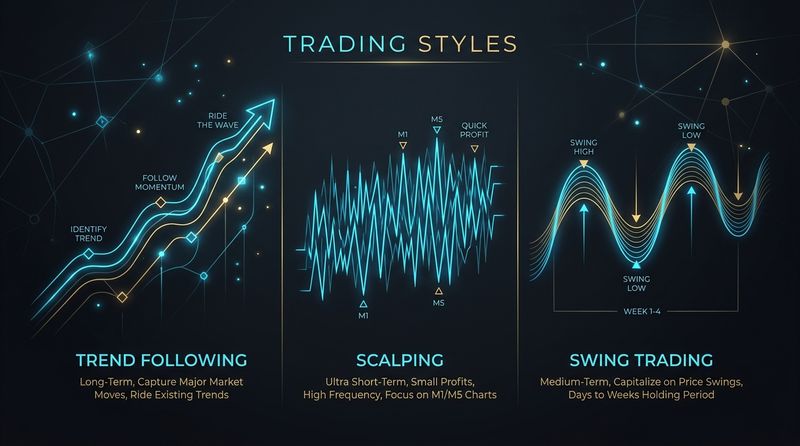
Think about a child on a playground swing. To go high, the child must pump their legs in sync with the swing's natural rhythm. They push at the peak of the backswing, accelerate through the bottom, rise to the front peak, pause briefly, and then fall back down. In the stock market, prices move in a similar oscillating fashion. They rarely rise or fall in a straight line; instead, they move in a series of impulses and corrections. Swing Trading is the art of identifying these natural market cycles, buying at the "swing low" (pullback) and selling at the "swing high" (peak) over a period of several days to weeks.
Swing trading sits in the sweet spot of the trading spectrum. It avoids the intense, minute-by-minute stress and high screen-time requirements of day trading, while offering far quicker compounding and cash flow than traditional buy-and-hold investing. If you have a full-time job but want to actively grow your wealth using technical analysis, swing trading is likely the perfect style for you. Let's explore how to read price swings, identify high-probability setups, and manage the unique risks of holding trades overnight.
The Swing Trader's Philosophy: Capitalize on the Swings
Traditional investors buy a company's stock and hold it through thick and thin, riding out 20% pullbacks because they believe in the company's 10-year future. Swing traders, on the other hand, want to bypass the boring consolidation phases and the painful downward corrections. They want to hold a stock *only* when it is in the active, high-velocity leg of its cycle.
When a stock in an uptrend pulls back, sellers get exhausted, and buyers step in, creating a pivot point called a swing low. The swing trader buys near this pivot point. As the stock surges upward, momentum builds, attracting retail chase buyers. When the price begins to stretch too far from its averages, the swing trader sells near the swing high, locking in a 10% to 25% profit. They then walk away with their cash, waiting for the next correction to repeat the process. By compounding these medium-term wins, a swing trader can potentially outperform the index over a market cycle.
Core Swing Trading Setups
Successful swing traders rely on a repeatable playbook of setups. Here are the three most common strategies:
1. The Moving Average Pullback
In a healthy uptrend, a stock will repeatedly pull back to its short-to-medium-term moving averages, which act as dynamic support levels. The 20-day Exponential Moving Average (EMA) and the 50-day Simple Moving Average (SMA) are the most popular lines of support. The strategy is to buy the stock when it touches the moving average, provided the overall trend is pointing upward, and place a stop-loss just below the average line.
2. Support and Resistance Reversals
This classic setup relies on horizontal price levels. When a stock breaks out above a major resistance ceiling, that level flips to become new support. A swing trader will wait for the stock to pull back and retest this breakout level. If the price stabilizes and bounces off the old ceiling (now a floor), they enter a long trade, targeting a run back to the recent highs.
3. The Flag and Pennant Continuation
After a sharp, high-volume upward rally (the "flagpole"), a stock will often consolidate sideways or slightly downward in a tight channel (the "flag"). This consolidation represents profit-taking by early buyers, while stronger hands absorb the shares. A swing trader buys the stock when it breaks out above the upper boundary of the flag, anticipating a secondary wave of buying momentum.
Swing Trading vs. Day Trading vs. Position Trading
Understanding where swing trading fits is crucial for choosing the right approach for your lifestyle:
| Parameter | Day Trading | Swing Trading | Position Trading |
|---|---|---|---|
| Holding Time | Minutes to Hours (Closed by 3:30 PM) | 2 Days to 4 Weeks | 1 Month to 12 Months |
| Time Commitment | High (constant screen monitoring) | Low (30-60 mins of analysis per day) | Very Low (weekly chart reviews) |
| Overnight Risk | None (100% cash overnight) | Moderate (exposed to market gaps) | High (exposed to long-term macro trends) |
| Leverage Used | High (5x margin) | None or Low (CNC / Cash basis) | None (100% cash equity) |
Managing the Hidden Danger: Overnight Gap Risk
Because swing traders hold positions for multiple days, their biggest risk is the overnight gap. A gap occurs when a stock opens significantly higher or lower than its previous day's close. This usually happens due to news released when the market is closed—such as corporate earnings, government policy changes, or global geopolitical developments.
If you buy a stock at ₹500 with a stop-loss placed at ₹480, and the company announces bad news after hours, the stock might open the next morning at ₹450. Your stop-loss will trigger at the opening price of ₹450, causing a loss that is much larger than you planned. To protect your portfolio from gap risk:
- Position Size Safely: Never concentrate all your capital into one or two stocks. Diversify your swing portfolio across 5 to 10 uncorrelated sectors.
- Avoid holding through earnings releases: If a company on your watchlist is scheduled to report its quarterly numbers tomorrow, do not enter a swing trade today. Earnings releases are binary events that can cause 10-15% gaps in either direction. Wait for the reaction, and trade the subsequent setup.
- Trade liquid stocks: Large, liquid stocks gap less violently and fill orders with minimal slippage compared to small-cap or micro-cap stocks.
Step-by-Step Swing Trading Blueprint for Beginners
- Scan the Market: Use stock screeners to find stocks trading above their 200-day and 50-day moving averages. Look for stocks with strong relative strength compared to the main index (Nifty 50).
- Wait for the Pullback: Do not buy a stock that is up 5 days in a row. Patiently wait for it to correct back to a key support level or its 20-day EMA.
- Identify a confirmation candle: Wait for a bullish candlestick pattern (like a hammer, engulfing bar, or morning star) to form at the support level, signaling that buyers are taking control.
- Set Stop-loss and Target: Place your stop-loss just below the swing low pivot. Set your target at the previous swing high, ensuring your risk-to-reward ratio is at least 1:2.
- Manage the trade: Once the price moves in your favor, protect your capital by moving your stop-loss to the break-even point. Use a trailing stop (like the 10-day EMA) to lock in profits as the trend extends.
Conclusion
Swing trading is a powerful, stress-efficient strategy to build wealth in the stock market. By mastering the art of buying swing lows in healthy uptrends and selling swing highs, you can repeatedly capture high-velocity moves while maintaining your day job. Success in swing trading does not require complex formulas; it requires the patience to wait for pullbacks, the discipline to size positions to handle overnight gap risks, and the emotional maturity to accept small losses when a support level fails. Align your trades with the natural waves of the market, protect your capital, and let the power of compounding build your wealth.
Educational & Regulatory Disclaimer
This publication is created strictly for educational and financial literacy purposes. InnocentInvestor is not a SEBI-registered investment advisor or research analyst. Stock market investments are subject to market risks; please consult a qualified financial planner before making investment decisions.