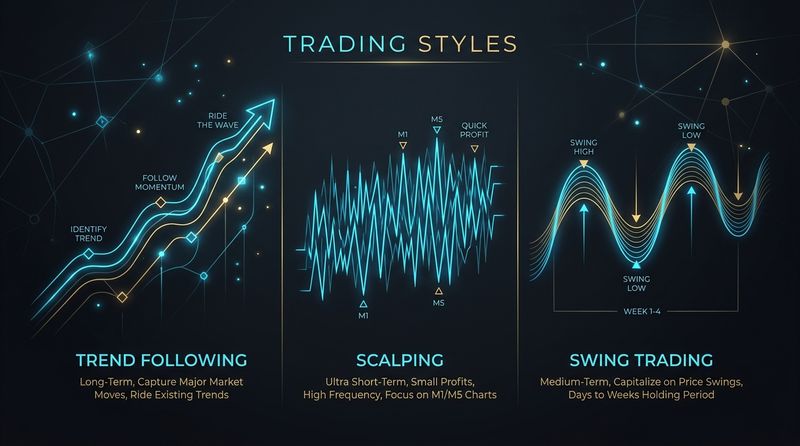
Imagine standing on the shore, watching a massive ocean wave build on the horizon. A novice swimmer might try to stand firm and resist it, only to be crushed by its sheer force. A skilled surfer, however, aligns their board with the wave's path, catches the momentum at the perfect instant, and rides it for hundreds of meters. In the financial markets, Trend Following is the equivalent of surfing. Rather than trying to predict where the market is going, trend followers wait for a wave (a market trend) to form, jump on it, and ride it for as long as possible.
Trend following is one of the oldest, most successful, and most misunderstood trading philosophies in history. While the average retail trader spends their days trying to "buy low and sell high," trend followers live by a counterintuitive maxim: "Buy high, and sell higher." They do not care about identifying cheap stocks, nor do they try to guess when a bull market will peak. Instead, they rely on systematic, rule-based systems to capture the middle 60-80% of a massive market move. If you have ever sold a stock that went up 20%, only to watch in agony as it went on to rise 500%, this article is for you.
The Core Philosophy: Ride the Wave, Cut the Anchor
The philosophical bedrock of trend following can be summarized in a simple phrase: "Let your profits run, and cut your losses short." Though it sounds like basic common sense, human psychology is hardwired to do the exact opposite. Behavioral economists have long documented the "disposition effect"—the tendency of investors to sell winning investments quickly to lock in a small gain, while holding onto losing investments in the vain hope that they will break even. A trend follower reverses this bias completely.
Trend followers accept that they cannot predict the future. They know that a stock trading at an all-time high is there for a reason, and it is more likely to keep rising than to suddenly crash. Conversely, a stock making new 52-week lows is in a downtrend and should be avoided or shorted. They use strict risk management rules to exit losing trades immediately before they turn into portfolio-destroying catastrophes, while leaving their winning trades alone until a clear trend reversal occurs.
The Turtle Traders: Proof of the System
Can trend following be taught, or is it an innate talent? This was the subject of a famous bet in 1983 between legendary commodity traders Richard Dennis and William Eckhardt. Dennis believed that trading could be reduced to a set of rules and taught to anyone. Eckhardt argued that successful traders possessed a natural "sixth sense" that could not be duplicated. To settle the debate, Dennis recruited a group of 14 ordinary people from various walks of life—including an actor, a card player, and a fantasy game designer—and trained them for two weeks in a systematic trend-following method. They were nicknamed the "Turtles."
Dennis gave the Turtles his own trading capital, and over the next four years, they generated an aggregate profit of over $175 million, proving beyond a doubt that a disciplined, rule-based trend-following system could turn novices into market wizards. The core of their system relied on buying breakouts above multi-week highs and immediately exiting if the trade moved against them by a factor determined by the asset's volatility.
Essential Tools for the Trend Follower
Systematic trend following does not rely on corporate earnings reports, balance sheets, or management meetings. It is purely technical. Below are the key tools traders use to identify and ride trends:
1. Moving Averages
Moving averages smooth out daily price noise to reveal the underlying direction of a stock. The two most common types are:
- Simple Moving Average (SMA): The average price of a stock over a specific number of days. The 200-day SMA is widely considered the ultimate line of demarcation between a bull and a bear market.
- Exponential Moving Average (EMA): Similar to the SMA, but it gives more weight to recent prices. This makes it react faster to sudden price shifts, making it popular among short-to-medium-term traders.
2. Moving Average Crossovers
A crossover occurs when a fast-moving average crosses a slow-moving average, signaling a shift in momentum:
- The Golden Cross: Occurs when the 50-day SMA crosses above the 200-day SMA. This is a classic long-term buy signal, indicating that a major bull market is underway.
- The Death Cross: Occurs when the 50-day SMA crosses below the 200-day SMA. This is a primary sell signal, warning of a potential bear market.
3. Trend Lines
A trend line is a diagonal line drawn across the chart connecting significant price points. In an uptrend, the line is drawn connecting the "higher lows." As long as the price remains above this line, the trend is considered intact. A clean break below the trend line is an early warning to exit or trim positions.
Trend Following vs. Counter-Trend Trading
To highlight the unique nature of this style, let's contrast trend following with counter-trend (mean reversion) trading:
| Parameter | Trend Following | Counter-Trend / Mean Reversion |
|---|---|---|
| Core Belief | Prices that are moving in a direction will keep moving. | Prices that move too far from their average will snap back. |
| Trade Entry | Buy breakouts and new highs ("Buy High, Sell Higher"). | Buy pullbacks and support bounces ("Buy Low, Sell High"). |
| Win Rate | Low (35% to 45%). Most trades are small losses. | High (60% to 75%). Most trades are small wins. |
| Risk-Reward Ratio | Excellent (1:3 to 1:10). Winners pay for all small losses. | Asymmetrical (1:1 or less). A few big losses can wipe out wins. |
| Psychological Pain | Taking frequent small losses; watching open profits evaporate. | Catching falling knives; being wrong when a trend doesn't stop. |
The Realities of Trend Following: The Whipsaw and Low Win Rates
If trend following is so profitable, why doesn't everyone do it? The answer lies in human psychology and the physical nature of markets. Markets only trend about 30% of the time. The other 70% of the time, they move sideways in a choppy, consolidated range. During these range-bound periods, trend following systems get "whipsawed." A trader buys a breakout, the price immediately reverses, and they are forced to sell for a small loss. This can happen five, six, or seven times in a row.
To survive as a trend follower, you must have the emotional discipline to accept a low win rate. Many professional trend-following funds win on only 40% of their trades. However, because they cut their losses at 2-3% while letting their winners run for 50%, 100%, or even 500% gains, a few massive winners easily cover all the small losses and generate outstanding net returns. Watching a massive 50% gain evaporate down to 20% before your trailing stop triggers is emotionally grueling, but it is the fee you pay to catch the 300% moves.
Passive Trend Following via Index Funds
For everyday investors who do not have the time to trade actively, there is a simple, highly effective way to participate in trend following: broad-market Index Funds. An index like the Nifty 50 or S&P 500 is, by design, a self-balancing trend-following system. It automatically allocates more capital to winning, growing companies as their market capitalization increases, while systematically reducing weight in declining companies and eventually kicking them out of the index entirely.
By investing regularly in a low-cost index fund, you are letting the market do the trend-following work for you. You ride the biggest secular bull markets in the strongest corporate giants, while your exposure to failing businesses is capped and eventually liquidated. It is the ultimate hands-off way to let your profits run over decades.
Practical Rules for a Systematic Trend Trader
- Never trade without a stop loss: Know your exit point before you enter a trade. If a stock falls below your predetermined price or moving average, sell it immediately. No excuses, no hope.
- Position size appropriately: Never risk more than 1% to 2% of your total account equity on a single trade. If you buy a stock at ₹100 with a stop loss at ₹90, and your account is ₹100,000, you should buy enough shares so that a ₹10 drop only loses you ₹1,000.
- Use a trailing stop: As the stock price rises, move your stop loss up behind it. You can trail using a short-term moving average (e.g., the 20-day EMA) or a volatility indicator like the Average True Range (ATR).
- Tune out the news: Media reports and analyst opinions are noise. The only thing that matters is price action. If the price is going up, buy. If it's going down, sell or stay away.
Conclusion
Trend following is not about being smart; it is about being disciplined. It requires you to set aside your ego, stop trying to prove you are smarter than the market, and accept that price is the ultimate truth. By systematically riding positive momentum, cutting your losses the moment the chart turns sour, and letting your winners run in bull markets, you can build sustainable, long-term wealth. Whether you choose to execute this actively through moving average crossovers or passively through low-cost index funds, aligning yourself with the path of least resistance is the closest thing to a golden rule in the financial markets.
Educational & Regulatory Disclaimer
This publication is created strictly for educational and financial literacy purposes. InnocentInvestor is not a SEBI-registered investment advisor or research analyst. Stock market investments are subject to market risks; please consult a qualified financial planner before making investment decisions.